
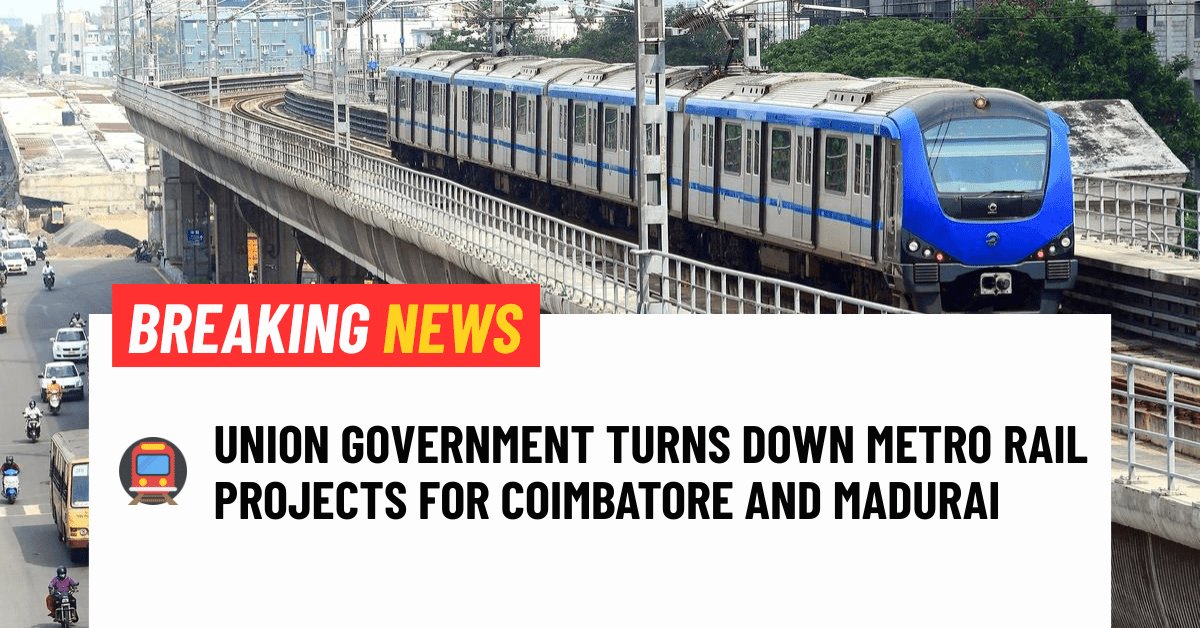
Union Government Turns Down Metro Rail Projects for Coimbatore and Madurai, Citing Population Clause
Advertisement
In a communication dated November 14, 2025 , the Ministry of Housing and Urban Affairs (MoHUA) conveyed to the Tamil Nadu government that both Coimbatore and Madurai do not meet the mandatory population requirement stipulated in the Metro Rail Policy, 2017 , which insists that a city must have a population of at least 2 million (20 lakh) , based on the 2011 Census , to qualify for a metro rail system.
According to the Ministry’s letter, Coimbatore has a population of 15.84 lakh and Madurai around 15 lakh as per the 2011 data for their core municipal limits – numbers that fall short of the policy threshold. The Ministry has therefore returned the Detailed Project Reports (DPRs) submitted for the Coimbatore Metro Rail Project and Madurai Metro Rail Project , effectively halting central approval for now.
For many in Tamil Nadu, this is not just an administrative setback. It feels like a political and developmental snub to two of the state’s most important urban centres.
What Exactly Did the Centre Say?
The communication from the Ministry of Housing and Urban Affairs to the Tamil Nadu government is blunt in its reasoning.
Officials pointed out that:
Under the Metro Rail Policy, 2017 , only cities with a population of 2 million or more are considered suitable for metro rail projects.
As per the 2011 Census , Coimbatore city’s population is 15.84 lakh , and Madurai’s is around 15 lakh when only the core city limits are taken into account.
Given this, the Ministry concluded that Metro Rail is “not justified” for these two cities at this time.
Instead, the Centre suggested that more cost-effective mass transport options such as a robust city bus system and Bus Rapid Transit System (BRTS) would be more appropriate, particularly for Madurai where the Comprehensive Mobility Plan (CMP) itself had endorsed BRTS as a suitable mode.
The letter underlined that metro projects are capital-intensive , involving huge upfront investments, complex engineering, and long-term financial commitments, and therefore must be planned carefully for long-term sustainability . On that basis, MoHUA said it was returning the DPRs rather than keeping them under consideration.
In bureaucratic language, the phrase “returned herewith” is polite but clear – the proposals are not being approved in their current form.
Tamil Nadu’s Response: “We Will Justify Our Case”
While the Centre’s decision appears categorical on paper, officials in Tamil Nadu are not giving up yet .
A senior State government official, speaking to local media, confirmed that the DPRs had indeed been returned but stressed that the communication also left space for further dialogue . According to this official, the Centre had effectively suggested that the State might “explore alternative modes of transport” if not Metro Rail.
At the same time, the official hinted that Tamil Nadu still plans to defend its case .
“Anyway, we will justify ,” the official said, indicating that the State intends to present updated population figures, urban agglomeration data and mobility projections to argue that both Coimbatore and Madurai do in fact meet the spirit, if not the letter, of the 2017 policy .
This sets the stage for what could become a prolonged tussle between State and Centre – not just over population numbers, but over how urban growth and mobility needs are interpreted in India’s rapidly expanding non-metro cities.
Are Coimbatore and Madurai Really “Too Small” for Metro?
One of the most contentious points in this entire episode is the use of 2011 Census data as the decisive benchmark.
Coimbatore: A Fast-Growing Industrial Hub
Coimbatore, often dubbed the “Manchester of South India” , is widely regarded as a major industrial, educational and IT hub. As per the 2011 Census:
Coimbatore city’s population (core municipal limits) was around 10.5–16 lakh , depending on how expanded limits are counted.
The urban agglomeration (wider metro region) had a population of over 21 lakh , crossing the 2 million mark even then.
Local business groups point out that since 2011:
The city has seen rapid growth in manufacturing, textiles, IT/ITES and startups.
New residential and commercial corridors have emerged along Avinashi Road, Sathyamangalam Road, and other major arteries .
The vehicular population and daily commuter volumes have soared, leading to increasing congestion and longer travel times.
Civil society groups argue that relying only on 2011 core city limits , rather than the wider urban agglomeration or current estimated population, grossly underestimates Coimbatore’s real size and mobility needs.
Madurai: Cultural Capital with Growing Urban Strain
Madurai, the historic “Temple City” and cultural capital of Tamil Nadu, also has a more complex demographic story than the bare figures suggest.
As per 2011 data:
Madurai city’s population was just over 10 lakh within the municipal limits.
Its wider urban agglomeration had nearly 14.7 lakh residents.
Since then, Madurai has witnessed:
Growth in tourism, education, healthcare, and small-scale industries .
Greater urban sprawl , with surrounding areas becoming more integrated into the daily economic life of the city.
Rising traffic congestion , especially near the Meenakshi Amman Temple , major junctions and bus terminals.
Tamil Nadu officials argue that real life urban dynamics – such as the functional city region and projected ridership – should weigh more than a static 2011 population snapshot , especially when no fresh Census has been held since then.
Business and Citizen Groups: “Deeply Disappointing and Disheartening”
The Union government’s decision has drawn strong criticism from local industry and civic groups , especially in Coimbatore.
J. Sathish, director of the Kongu Global Forum , expressed what many in the region are feeling:
He pointed out that 65 lakh people use the Metro every day in Delhi , around 10 lakh in Bengaluru , and 3 lakh in Chennai , highlighting how a well-planned metro system can transform urban mobility and reduce road congestion .
He recalled that Coimbatore was identified as suitable for Metro Rail as early as 2010 , yet after 15 years of studies, planning and expectations, the city is now being told that it “doesn’t qualify”.
Calling the decision “deeply disappointing and disheartening” , Sathish argued that:
The voter population of Coimbatore district is around 3 million , which implies an actual population of at least 4 million when non-voters like children are included.
The absence of a post-2011 Census means cities like Coimbatore are being penalised based on outdated data , even as their actual population and economic profile have grown significantly .
He warned that without a metro:
“We will be pushed back by 10 years in public transport.”
He has urged the Prime Minister to reconsider the decision and asked the Centre to approve the Metro projects , arguing that Coimbatore’s profile is comparable to other tier-two cities that already have metro networks , such as Jaipur, Kochi and Nagpur.
The Metro vs. BRTS Debate: What Do These Cities Really Need?
Advertisement
The Centre’s letter doesn’t just reject the metro – it also suggests alternatives .
For Madurai , the Ministry has specifically referred to the Comprehensive Mobility Plan , which concluded that a Bus Rapid Transit System (BRTS) would be more suitable. For both cities, MoHUA has suggested:
Strengthening city bus services
Considering BRTS corridors
Exploring other cost-effective transport solutions before investing in something as capital-intensive as a metro
What is BRTS?
A Bus Rapid Transit System typically features:
Dedicated bus lanes separated from mixed traffic
Priority signalling at junctions
High-capacity articulated or standard buses
Level boarding at stations and smart ticketing
BRTS is usually cheaper and faster to implement than metro , but it may:
Offer lower capacity per corridor compared to heavy metro systems
Be more vulnerable to traffic interference if enforcement is weak
Face public perception issues , as many commuters view metro rail as a more modern, comfortable and long-term solution
Critics of the Centre’s decision say that while BRTS and better buses are welcome , they cannot fully substitute for a metro in densely built, high-growth corridors like those in Coimbatore and parts of Madurai.
Policy Questions: Is the Metro Rail Policy Being Applied Evenly?
Beyond state-centre politics, the episode has sparked serious policy questions :
Why rely strictly on 2011 Census data when it is widely acknowledged that urban populations have expanded considerably since then , especially in fast-growing cities like Coimbatore?
If cities such as Agra, Bhopal and Patna – which also have populations below 2 million in their core city areas as per 2011 data – can receive metro approvals , why not Coimbatore and Madurai?
Should the policy consider urban agglomeration or planning area population , rather than just the municipal limit population , especially in regions where urban sprawl is extensive?
How should projected ridership, economic importance, and regional connectivity factor into metro decisions, over and above raw population numbers?
For Tamil Nadu, these questions aren’t academic. The state has positioned Coimbatore as a major growth engine in the western region and Madurai as a key hub in the south. The absence of a metro, many argue, could slow down long-term economic competitiveness.
What Happens to the DPRs and Preparatory Work?
Over the last few years, Tamil Nadu has invested heavily in planning for metro systems in both cities.
Coimbatore Metro
The Coimbatore Metro proposal envisaged key corridors along Avinashi Road and Sathyamangalam Road , covering over 40 km in the first phase.
DPR preparation and preliminary planning were led by Chennai Metro Rail Limited (CMRL) .
Budget announcements in recent years have already earmarked thousands of crores for preliminary works and land-related activities.
Madurai Metro
The Madurai Metro DPR proposed a network spanning nearly 29 km with multiple stations across core areas of the city.
RTI replies and official statements earlier in 2025 suggested that the projects were “under consideration” at the Centre, before the present rejection.
With the DPRs now returned , several questions arise:
Will the State rework the proposals as a lighter system , such as MetroLite or a high-capacity BRTS?
Will Tamil Nadu resubmit updated DPRs with revised population and ridership projections?
Could the State consider implementing metro systems with more state funding and less central support , though that would be financially challenging?
For now, officials from CMRL have indicated in other contexts that they view the rejection as a “temporary setback” rather than the end of the road , and that they plan to furnish detailed clarifications to keep the projects alive.
What Could Happen Next?
Despite the setback, this may not be the final word on metro rail for Coimbatore and Madurai.
Several possible paths lie ahead:
Re-presentation of DPRs with updated data The Tamil Nadu government may compile new population estimates , urban agglomeration figures , and ridership projections to argue that the cities effectively meet the metro criteria in terms of demand and density , even if the 2011 Census numbers say otherwise.
Lobbying for a flexible interpretation of the policy The State could push for a broader reading of the Metro Rail Policy , emphasising that economic importance, regional role and future growth should weigh just as heavily as population figures.
Hybrid solutions: Metro + BRTS + Bus upgrades Even if full-fledged heavy metro gets delayed, Tamil Nadu might roll out BRTS corridors, better city buses and limited higher-capacity rail options to meet immediate needs, while continuing to lobby for metro approval in the long term.
Public pressure and civic campaigns Business groups, residents’ associations and commuter organisations in both cities may step up advocacy , organising petitions and campaigns to press both State and Centre to find a middle path.
Whatever happens, Coimbatore and Madurai are unlikely to quietly accept a future without high-capacity mass transit . Their growth trajectories almost guarantee that the metro debate will resurface repeatedly in the years to come.
Conclusion: A Decision That Could Shape Two Cities’ Futures
The Union government’s move to reject the Metro Rail proposals for Coimbatore and Madurai may look like a technical decision grounded in population norms and policy guidelines , but its implications go far beyond spreadsheets and census tables.
For Coimbatore , a dynamic industrial powerhouse, and Madurai , a historic cultural centre with growing urban pressures, the decision raises serious concerns about how India plans mobility for its second-tier cities . It has triggered anger among local stakeholders , accusations of uneven policy application , and a renewed examination of how population thresholds, urban agglomeration data and projected ridership are used to decide which cities “deserve” a metro.
At the same time, the Centre’s stance highlights a valid concern: metro projects are expensive and complex , and not every city can or should rush into them without solid ridership numbers and financial viability . Alternatives like BRTS and upgraded bus systems can, in theory, offer cheaper, flexible solutions if designed and implemented well.
In the coming months, much will depend on how Tamil Nadu responds – whether it can marshal convincing data , refine its proposals , and build consensus around a sustainable mobility plan that satisfies both local aspirations and central guidelines . For now, what’s clear is that the people of Coimbatore and Madurai are not ready to give up on the dream of a metro , and the debate over their urban future is far from over.
Advertisement