
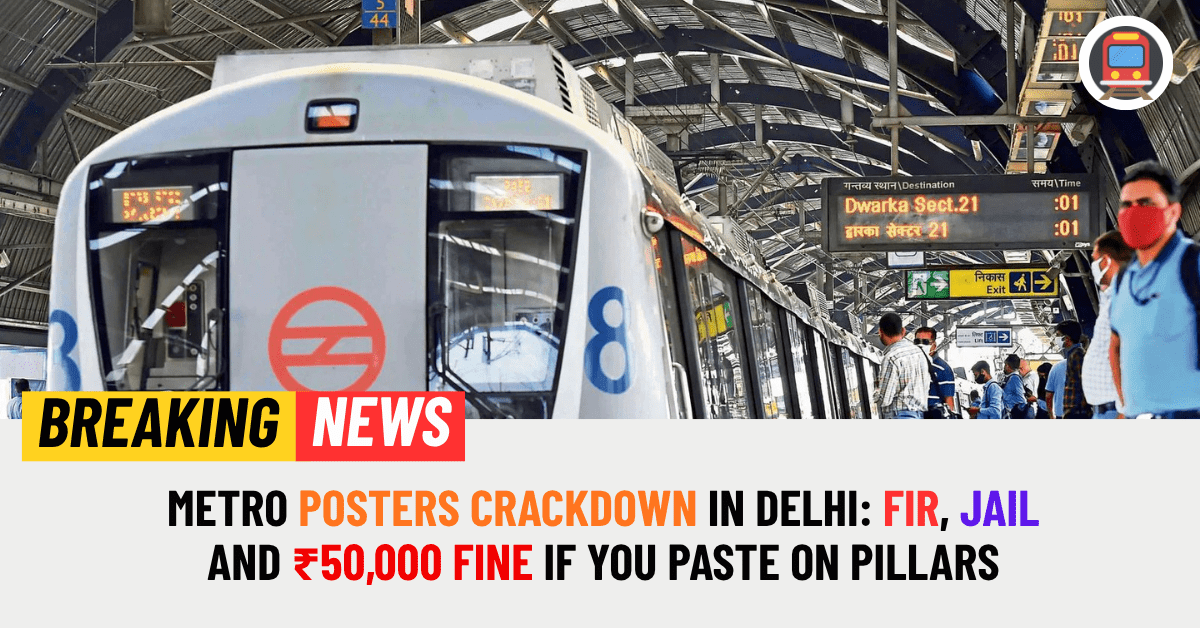
Metro Posters Crackdown in Delhi: FIR, Jail and ₹50,000 Fine if You Paste on Pillars
Advertisement
Delhi Metro is not just a transport system anymore; it’s a symbol of the capital’s identity, discipline and modern infrastructure. But along with lakhs of daily passengers, there is also a growing problem that has been spoiling the look of this world-class network – random posters, stickers and advertisements pasted on metro pillars, walls and station premises.
In this detailed report, we break down what exactly has changed, why this step has been taken, what the law says, who will be affected, and how this move fits into the broader cleanliness and civic responsibility campaigns in the national capital.
Delhi Metro’s Warning: Posters on Pillars Can Land You in Jail
To keep Delhi Metro premises clean and visually clutter-free, DMRC has issued clear instructions to Delhi Police. If anyone is found pasting posters, banners or stickers on metro property, the police will now register an FIR (First Information Report) based on DMRC’s complaint.
This directive has been formally communicated through a letter sent by DMRC’s Chief Security Commissioner, Suvashis Chaudhary, to Delhi Police. In this letter, he has requested that every complaint filed by DMRC in such cases be treated seriously and converted into a formal FIR.
The idea is simple: earlier, many such violations were ignored or treated casually. Now, with FIR and criminal action in the picture, authorities want people to think twice before defacing metro pillars and stations with posters.
Why This Crackdown Now? The Link With Delhi’s Cleanliness Campaign
This move is not random or isolated. It is closely linked with the ongoing cleanliness and beautification campaign in Delhi, being run by the government to make public spaces cleaner, safer and more organized.
Under this campaign, metro properties – such as:
Pillars along the metro corridors
Station entry and exit walls
Foot-over-bridges connected to metro stations
Boundary walls and signboards
have been identified as highly visible public assets that must be kept free from visual pollution.
According to sources, Chief Minister Rekha Gupta (as mentioned in the original report) also directed DMRC to ensure that no posters are pasted on its premises or infrastructure. Following these directions, DMRC has taken this stricter legal route so that there is a clear deterrent against those who misuse metro walls and pillars as free advertising boards.
The Legal Backbone: Delhi Prevention of Defacement of Property Act, 2007
The most important part of this story is the law under which these FIRs will be registered.
The crackdown on posters is being done under the Delhi Prevention of Defacement of Property Act, 2007. This Act was specifically brought in to stop people from defacing public and private properties by pasting posters, writing slogans, painting walls or sticking advertisements without permission.
Under this law:
Defacement of property is a punishable offence.
It includes:
Pasting posters
Scribbling or writing on walls
Unauthorized banners and hoardings
If found guilty, the person can face:
Up to one year of imprisonment,
A fine of up to ₹50,000,
Or both jail and fine, depending on the seriousness of the violation.
In simple words, sticking one poster on a metro pillar can technically be enough to get you jailed or heavily fined if a complaint is filed and the case is pursued.
By invoking this Act, DMRC and Delhi Police want to send a strong message that metro property is not to be treated as a free advertising surface.
What Counts as “Defacement” of Metro Property?
Many people may assume that only large hoardings or political banners are illegal, but the law is much wider. Under the defacement law, even a small sticker or notice can count as defacement if it is:
Pasted without permission, and
On public or private property where it is not allowed.
For metro specifically, the following would be considered defacement if done without authorization:
Pasting tuition posters on metro pillars
Sticking PG/room-on-rent advertisements
Putting up political rally posters
Promoting coaching institutes, events, exhibitions or private businesses through pamphlets and stickers
Writing slogans or painting promotional content on metro walls or station boundaries
Even those “tear-away” posters with phone numbers at the bottom that are often found on pillars and walls are covered under this prohibition.
In short, anything that spoils the original look of metro property, without DMRC’s prior permission, can attract legal action.
DMRC’s Letter to Police: From Complaint to FIR
According to information shared by sources, DMRC’s Chief Security Commissioner Suvashis Chaudhary has made it clear in his letter that:
Whenever DMRC files a complaint regarding defacement of metro assets,
Delhi Police should register an FIR under the Delhi Prevention of Defacement of Property Act, 2007.
This is important because earlier, in many cases, such complaints could be treated as minor issues, settled on the spot or ignored due to lack of seriousness. Now, with explicit instructions, police will be expected to treat these complaints as criminal matters.
This means:
More cases will formally enter the justice system,
There will be a record against repeat offenders,
And awareness will spread that pasting posters on metro pillars is not a harmless act—it is a crime.
Who Will Be Held Responsible – Poster Paster or the Advertiser?
A big question that arises is: Who will face the FIR – the person pasting the poster or the person whose business/face is on the poster?
Under defacement law, both can be held responsible in different situations:
The person caught in the act of pasting the poster is clearly liable.
The organization, coaching centre, political party, or individual whose name, phone number or logo is printed on the poster can also be booked, as they are deemed to have authorized or benefited from the act.
This means businesses and coaching institutes that rely on this cheap, illegal method of promotion can no longer plead ignorance. If their posters are found on metro property, they may find themselves facing legal trouble.
So, it’s not just the person with a bucket of glue and a stack of posters who needs to be careful – even the person printing those posters with a contact number or brand name must rethink their advertising strategy.
From “Chalta Hai” to Zero-Tolerance: A Cultural Shift
For years, defacement of public property has been normalized in Indian cities. Metro pillars, flyover walls, footpaths and street corners often get plastered with layers of posters—political rallies, coaching classes, astrology services, property dealers, events and sales, and more.
This creates:
Advertisement
Visual clutter and ugliness,
Difficulty in maintenance and cleaning,
A sense that public property is “no one’s responsibility”,
And sometimes even safety issues, as important signage may get covered.
By choosing to strictly enforce the defacement law on its own property, DMRC is trying to reverse this “chalta hai” attitude and move towards a culture where:
Public infrastructure is respected,
Cleanliness is taken seriously,
And there are real consequences for those who damage or misuse it.
In many global cities, metro or subway systems are extremely strict about cleanliness and order. Delhi Metro, which is often compared to top international networks, seems to be moving more firmly in that direction.
Impact on Political Parties, Coaching Centres and Local Businesses
The new enforcement can significantly affect several groups that heavily rely on low-cost poster advertising:
1. Coaching Centres and Tuition Classes
These are among the biggest users of wall posters and stickers, especially near metro pillars, bus stops and colleges. The crackdown means:
They can no longer treat metro pillars as their permanent notice boards.
They will have to shift to legal advertising channels like authorized hoardings, digital ads or online marketing.
If caught, owners and promoters may face FIRs and heavy fines.
2. Local Businesses and Property Dealers
Many small businesses, PG/room rental agencies and local shops put up posters around metro stations to reach footfall. Now:
They will have to avoid metro property completely.
They could face legal action if their posters are spotted by DMRC authorities or police.
3. Political Groups and Student Organisations
Before elections or protests, walls and pillars often get covered with political posters. Under the new enforcement climate:
Political and student groups may come under stricter watch.
Use of metro property for political messaging may invite criminal cases against organizers and those whose names appear on posters.
In all these cases, the core message is the same: metro property is off-limits.
How Will This Help Keep Metro Property Clean?
This step is not just symbolic. Legal enforcement backed by a strong Act and clear penalties has real impact. Here’s how:
Fear of legal action: The possibility of an FIR, court case, jail term and a fine up to ₹50,000 will make many people and businesses think carefully before putting up illegal posters.
Repeat offenders can be tracked: Once cases are registered, authorities can identify and act against repeat violators more effectively.
Better maintenance cycle: With fewer posters to remove and repaint, DMRC can save on cleaning costs and focus more on maintaining stations and trains.
Better passenger experience: A clean environment automatically feels safer, more modern and more pleasant to use.
Signal to the public: It sends a strong message that public transport infrastructure is valuable and must be respected, not misused.
In essence, this is not just about posters, but about changing public behaviour.
What Citizens Need to Keep in Mind
If you live in Delhi or use the metro regularly, here are some key points you should remember:
Do not paste posters, banners or stickers on any metro pillar, wall, station or related property.
Even if “everyone else is doing it”, it is still illegal and now strictly punishable.
If you run a business, coaching centre, PG or local service, do not promote it through posters on metro property. Use legal advertising routes instead.
Be aware that your name or number printed on a poster can link you to the offence, even if you did not personally paste it.
As a responsible citizen, you can also discourage others from defacing public property and, if needed, inform authorities when you see large-scale defacement.
Role of Delhi Police: From Passive to Proactive
With DMRC’s letter in place, Delhi Police now has a clearer mandate:
Register FIRs whenever DMRC lodges a complaint involving defacement of metro assets.
Take action under Delhi Prevention of Defacement of Property Act, 2007 without delay.
Support DMRC’s efforts in maintaining cleanliness and order in and around metro premises.
Earlier, such matters may have been seen as minor nuisances, but this directive aims to make enforcement more consistent and serious.
If implemented strictly, this can:
Increase accountability,
Reduce visual pollution,
And complement other efforts like anti-littering drives, urination fines and no-smoking enforcement near metro stations.
Clean Metro, Clean City: The Bigger Picture
Delhi has been trying to project itself as a modern, global city with improved public transport, better roads, cleaner markets and more organized public spaces. Delhi Metro has always been one of the biggest success stories in this journey.
By keeping its infrastructure clean, well-maintained and graffiti-free, DMRC has already set a positive example. This new focus on removing and preventing posters on pillars and property is another step in that direction.
A clean metro environment:
Enhances the city’s image in the eyes of visitors and tourists,
Improves the everyday experience for lakhs of commuters,
And sends a message that rules are meant to be followed, not ignored.
In many ways, how we treat public property reflects how seriously we take our role as citizens.
Conclusion: Posters on Metro Property Are Now a Serious Legal Risk
In summary, pasting posters on Delhi Metro pillars and property is no longer a small, ignorable offence. With DMRC formally directing Delhi Police to file FIRs under the Delhi Prevention of Defacement of Property Act, 2007, such acts can now lead to:
Criminal cases (FIR)
Up to one year of imprisonment
A fine up to ₹50,000, or
Both jail and fine, depending on the case.
This strict action is part of a larger cleanliness and civic discipline drive in the capital, backed by directions from the government to keep metro premises free from visual pollution. It targets not just the person physically pasting the posters, but potentially also the businesses, coaching centres and organizations that benefit from such illegal advertising.
For ordinary citizens and business owners alike, the message is very clear: Delhi Metro property is not your advertising space. Treat it with respect, follow the rules, and contribute to a cleaner, more organized city.
Advertisement