
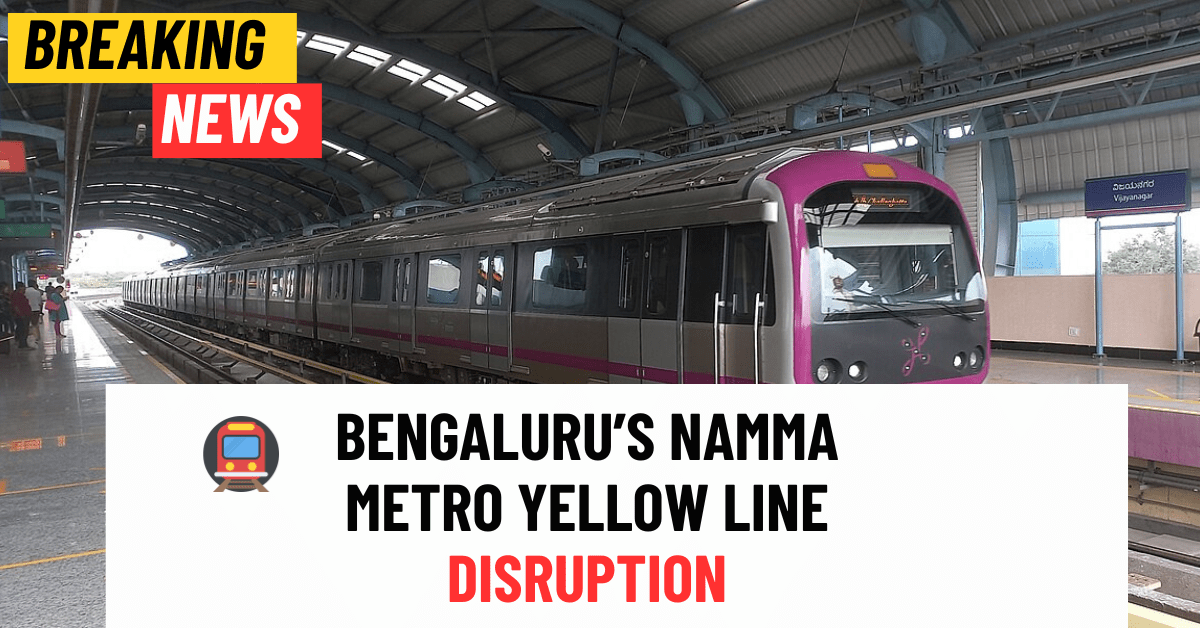
Bengaluru’s Namma Metro Yellow Line Disruption: Commuter Protest Over Early Morning Timings Sparks Debate
Advertisement
On the surface, it was a brief disruption. But behind those 35 minutes lies a much deeper story about growing demand, operational constraints, and frustration among daily riders who feel they are being ignored.
In this detailed report, we break down what happened, why it happened, what the law says, how BMRCL responded, and what it could mean for the future of the Yellow Line and Namma Metro services in Bengaluru.
What Exactly Happened on the Yellow Line?
On Monday morning, services on the Yellow Line of Namma Metro, which connects Rashtreeya Vidyalaya Road (RV Road) and Bommasandra, were disrupted starting from around 6:00 am.
A group of passengers at RV Road Metro station staged a protest by standing between the coach doors of the first train, preventing them from closing. As a result, the train could not depart, and metro operations on the line were stalled for about 35 minutes, until around 6:35 am.
These passengers weren’t just randomly blocking the train — they had a specific demand:
They wanted Namma Metro to start Yellow Line operations earlier, in line with other metro lines in the city, and address issues of low train frequency and delays.
While the Purple Line and Green Line begin operations as early as 4:30 am, the Yellow Line currently starts at 6:00 am. This gap in timing, especially for those who depend on early-morning metro services to reach workplaces or transit hubs, has become a major point of frustration.
Why Were Commuters So Angry? The Main Issues Behind the Protest
The commuters at RV Road were not protesting just for the sake of it. Their anger stemmed from three key issues:
1. Delayed Start of Services on Yellow Line
While other Namma Metro lines start operations at 4:30 am, the Yellow Line starts at 6:00 am.
For many office-goers, factory workers in Bommasandra, students, and shift employees, those early hours are crucial.
Passengers say that aligning the Yellow Line’s start time with the other lines would significantly help those who rely on seamless early-morning connectivity.
2. Low Train Frequency During Peak Hours
Even though the Yellow Line is relatively new, passengers claim they face:
Long waiting times between trains, especially during morning and evening peak hours.
Overcrowded coaches when trains finally arrive, adding to commuter stress.
According to BMRCL’s own update, the waiting time during peak hours was reduced from 19 minutes to 15 minutes after an additional trainset was added. But for many regular riders, even 15 minutes is still too long, given Bengaluru’s growing dependency on metro services.
3. Perception of Inequality Between Metro Lines
Commuters also feel that the Yellow Line, despite being a vital link that connects residential neighborhoods, IT hubs, and industrial areas, is not being treated on par with the well-established Purple and Green lines.
They argue:
If other lines can operate from 4:30 am, why not the Yellow Line?
The demand on this corridor is already high, with many working-class and industrial area commuters relying on it.
The delay in extending operational hours is seen by some as lack of prioritization.
How the Protest Unfolded at RV Road Station
According to the statement and reports:
The first train of the day on the Yellow Line was scheduled to leave RV Road station at 6:00 am.
A group of passengers boarded the train but intentionally blocked the coach doors, physically standing in the doorway to prevent them from closing.
Bangalore Metro Rail Corporation Limited (BMRCL) staff attempted to intervene:
They tried to convince the passengers to step aside and allow services to begin.
They reportedly explained the current operational constraints and ongoing efforts to improve frequency.
However, the protesting passengers refused to relent, continuing to obstruct the train and halting operations in the process.
This door-blocking strategy not only stopped the departure of the first train but also affected subsequent train movements, as metro operations depend on every train sticking to a tight schedule.
As a consequence, Namma Metro had to short-loop one of the trains at Central Silk Board, which means that instead of continuing its full route, the train service was cut short to stabilize operations on the line.
BMRCL’s Official Response: “Deliberate Obstruction” and Safety Concerns
Following the incident, BMRCL issued a formal statement confirming that:
A group of people deliberately blocked the departure of the first Yellow Line train by obstructing the doors.
This impacted service stability and forced operational adjustments, including short-looping a train at Central Silk Board.
BMRCL emphasized that such actions:
Cause inconvenience to a large number of passengers.
Affect the safety and smooth functioning of the metro system.
Disturb not only those on the Yellow Line but also interconnected services and schedules.
The corporation also revealed that a police complaint has been filed against the protesters to initiate legal action.
What the Law Says: Metro Act Provisions and Possible Punishments
The protest didn’t just delay trains—it may now have legal consequences for those involved.
Under the Metro Railways (Operation and Maintenance) Act, 2002, obstructing metro operations is a punishable offense. Actions such as:
Blocking train doors
Obstructing railway staff
Interfering with the safe running of trains
Causing disturbance in railway premises
can attract:
Imprisonment, or
Fines, or
Both, depending on the severity and nature of the offense.
BMRCL’s statement specifically mentions that:
Such disruptions are taken seriously under the Metro Railways (Operation and Maintenance) Act, 2002, and can result in imprisonment and/or fines.
By filing a formal complaint with the police, BMRCL has signaled that it intends to pursue the matter legally, likely to set an example and deter similar protests in the future.
Service Resumption: How Operations Were Stabilized
After about 35 minutes of disruption, services on the Yellow Line resumed around 6:35 am.
However, to stabilize the system:
One of the trains had to be short-looped at Central Silk Board, meaning it did not complete the full route as originally scheduled.
This move is a common operational tactic used by metro systems worldwide to bring services back on track after disruptions.
While it helped the control center regain rhythm, it may have inconvenienced passengers further down the line, who would have had to wait for additional trains.
From BMRCL’s point of view, the priority was clear:
restore safety, normalize headways, and bring the line back to a predictable schedule as quickly as possible.
Yellow Line’s Recent Improvements: Earlier Start and Better Frequency
It is important to note that the Yellow Line has seen some recent improvements, even before this protest.
Start Time Advanced from 6:30 am to 6:00 am
From November 1, BMRCL added the fifth trainset to the Yellow Line.
This allowed them to advance the start of operations from 6:30 am to 6:00 am.
BMRCL has projected this as a positive step towards improving commuter convenience.
However, as the protest shows, many passengers are still not satisfied, because the gap between 4:30 am (other lines) and 6:00 am (Yellow Line) remains a serious issue for early commuters.
Waiting Time Reduced from 19 Minutes to 15 Minutes
With the addition of the new trainset, BMRCL claims that:
The peak-hour train waiting time on the Yellow Line has been brought down from 19 minutes to 15 minutes.
While this is technically an improvement, commuters still find 15 minutes too long during rush hours on a busy corridor like this one.
Plans for Further Improvement
BMRCL has also said that:
Services on the Yellow Line will further improve once more trainsets are introduced in the coming months.
The goal is to:
Reduce waiting times further.
Increase capacity.
Provide smoother connectivity along the RV Road–Bommasandra corridor.
BMRCL Using All Trains – But at a Cost
In its statement, BMRCL also highlighted that:
100 per cent of available Yellow Line trains are currently being used during peak hours.
This means:
All trainsets assigned to the Yellow Line are deployed simultaneously during busy periods.
There is currently no spare trainset held in reserve during peak time.
While this might seem like good news for commuters, it also comes with a serious operational risk:
If any train develops a technical fault, there is no standby train available to take its place immediately.
This can lead to delays, cancellations, and extended waiting times, especially during large disruptions or unexpected glitches.
Advertisement
In simple terms, BMRCL is stretching its existing fleet to the maximum on the Yellow Line to keep passengers happy, but this may not be sustainable in the long run without adding more trains.
The Bigger Picture: Balancing Commuter Needs and Operational Realities
The RV Road protest raises an important question that goes beyond just one morning’s delay:
How should public transport operators like BMRCL respond when commuters feel ignored or underserved, but also take steps that put safety and operations at risk?
On one hand:
Commuters are justified in their desire for:
Earlier start times.
Higher frequency.
Reliable services that match their work and personal schedules.
On the other hand:
BMRCL has constraints, including:
Limited number of trainsets.
Maintenance requirements.
Operational safety standards.
Staff scheduling and overnight system checks.
Starting a line earlier is not just about opening the gates 90 minutes sooner — it involves:
Staff deployment, including train operators, station controllers, security, and maintenance teams.
Ensuring tracks and signals are checked and safe.
Adjusting energy, security, and backup systems.
So while the demand for 4:30 am operations on the Yellow Line is understandable, it may require:
Additional trains.
Revised staffing policies.
Tweaked maintenance schedules.
Increased budget and planning.
Are Protests Like This Justified—or Dangerous?
The method of protest is at the heart of the current controversy.
From the Commuter’s Perspective
They feel ignored despite repeated complaints and requests.
Many daily riders believe that peaceful petitions or feedback forms do not lead to change.
For such passengers, dramatic actions like blocking train doors seem like the only way to get attention from authorities and the media.
From BMRCL’s and Safety Perspective
Blocking train doors is not a harmless act; it directly interferes with the safety of train operations.
Metro trains and stations are designed with strict safety standards, and any obstruction can:
Delay operations for thousands of commuters.
Cause overheating or technical stress on doors and systems.
Lead to unsafe crowding on platforms and inside trains.
This is why BMRCL has chosen to file a police complaint, stressing that such disruptions cannot be encouraged or normalized.
Striking a Balance
There is a delicate balance to be maintained:
Commuters need an effective channel to voice grievances and push for genuine improvements.
Metro authorities need to act transparently, communicate timelines, and show progress.
But protests that endanger operations or safety are likely to be met with strict legal action.
What This Means for Daily Commuters on the Yellow Line
For the average person who takes the Yellow Line regularly, this incident has multiple implications:
Short-Term Impact
There may be increased security and monitoring at key stations like RV Road and Central Silk Board.
Authorities might remain extra cautious during early-morning services.
Some commuters may worry about further disruptions if similar protests are repeated.
Medium-Term Changes
BMRCL could come under pressure to review Yellow Line timings and frequency more seriously.
Commuter associations or resident welfare groups may formally engage with BMRCL to push for:
Earlier start times.
More trains during peak hours.
Better communication of changes and schedules.
Long-Term Possibilities
As more trainsets are inducted, Yellow Line services are likely to become:
More frequent.
More reliable.
Better aligned with the overall Namma Metro network.
If BMRCL responds positively, this incident could become a turning point for service improvement on the line.
Could the Yellow Line Eventually Start at 4:30 AM Like Other Lines?
This is the big question on many commuters’ minds.
Right now:
The Yellow Line starts at 6:00 am.
Purple and Green Lines start at 4:30 am.
From an operational perspective, matching the Yellow Line’s timings with the older lines would require:
Additional trains dedicated to early-morning operations.
More staff on duty during extended hours.
System checks and maintenance schedules to be shifted accordingly.
While BMRCL has not yet officially announced any plan to shift the Yellow Line start time further earlier, the pressure is clearly mounting.
If passenger demand continues to grow and more trainsets are introduced, it is possible that the start time could eventually be moved earlier. But such a change is likely to be gradual and dependent on resource availability and ridership data, rather than protests alone.
Conclusion: A Wake-Up Call for Both Commuters and BMRCL
The 35-minute disruption on Bengaluru’s Namma Metro Yellow Line may look like a minor operational blip on paper, but in reality, it reflects a growing tension between commuter expectations and system limitations.
On one side are frustrated passengers, many of whom rely on metro services to reach work on time and navigate a city notorious for traffic jams. They want earlier start times, higher frequency, and better reliability, especially on a crucial corridor like the RV Road–Bommasandra Yellow Line.
On the other side is BMRCL, which is attempting to stretch its limited fleet to its maximum, operating 100 per cent of available trains during peak hours and gradually improving timings and frequency as more trainsets are added. However, operational safety, staffing, and maintenance constraints cannot be ignored.
What happened at RV Road station underscores an important reality:
Public transport cannot function smoothly without mutual responsibility.
While commuters have every right to demand better services, blocking doors and disrupting operations puts thousands of others at risk and violates the law.
At the same time, BMRCL must proactively communicate service plans, listen to legitimate concerns, and work towards bringing Yellow Line operations closer to the standards of the other metro lines.
In the coming months, much will depend on:
How quickly additional trains can be deployed.
Whether BMRCL adjusts timing and frequency on the Yellow Line further.
How both sides – authorities and riders – choose to engage with each other.
For now, the incident stands as a powerful reminder that Bengaluru’s metro system is not just about trains and tracks, but about people, priorities, and planning — and finding the right balance between them is more important than ever.
Advertisement